Lakehouse
is a constellation of boards that work together to form interactive hardware. This often means synthesizers, but Lakehouse supports anything that needs flexible distributed hardware control (like VMK'26)
The ideas around Lakehouse came from what did and didn't feel good about the creatively named "H750 Synth Dev Platform" that the first 2025 hardware Jazzman and Pebbles were built on. That board tried to do too much at once, but it proved that a flexible hardware concept could indeed allow fast iteration and idea exploration. Pebbles wouldn't exist without it! But the "have lots of ADC headers" idea was buns from a few angles:
Routing that many cables from wherever the controls are to the central PCB. Big tangle and unnecessarily messy.
Requiring the main DSP engine to sample and smooth a ton of analog inputs.
Tying physical IO location to the rest of the instrument guts. This worked for Pebbles but was still a little awkward. The IO needs to go "somewhere" and the rest of the guts do not need to, and often don't want to, be in the same spot.
I realized I needed a control-agnostic engine that could receive data from anyone ready to format it right, with a clean way to connect to the outside world without committing to one arrangement.
Why "Lakehouse"? It's a manifestation exercise. I want a lake house... It doesn't have to literally be a lake house, but "lakehouse" is an ethos. Like, sit by the water, host your buds.
The boards:
IO
IO handles the physical connectors for power, audio, and MIDI. It's small and happy to live wherever in an enclosure.
IOⲁ (alfa): USB-C power / MIDI, TRS MIDI in and out, stereo 1/8" audio out.
IOϧ (khei): USB-C power / MIDI / Audio.
Status: Pretty sure I know what this should look like, no real design work done on it yet though.
DSP
An STM32H750 and NAUC22YG audio codec. This board handles audio input, signal processing, and output. dsp sends and receives analog audio and receives control data over USART from one of its handful of headers. Just DSP and IO together could theoretically make an instrument or sound device.
Status: mostly designed, no PCB yet.
Keys
Scans a key matrix. Conceived for the big stack of 37-key keybeds I have, but would work just as well for a numpad or a bank of buttons. Has a dedicated MCU of some sort with a serial output. Could have an unpopulated or just out of the way USB connector and double as a standalone USB-ifyer.
Status: slow going. I know exactly what it needs to be, which is the worst spot. No oomph in the problem, it's just a thing I know how to build. Yawn!
Buoys
or... Nodesmen? They are serial control nodes. It's a PCB just big enough for an encoder and headers. They are daisy chained and feed their MIDI like serial data down the chain to some receiver like the DSP board. You can send queries up the chain, name nodes, whatever your little embedded heart desires and can write the code for.
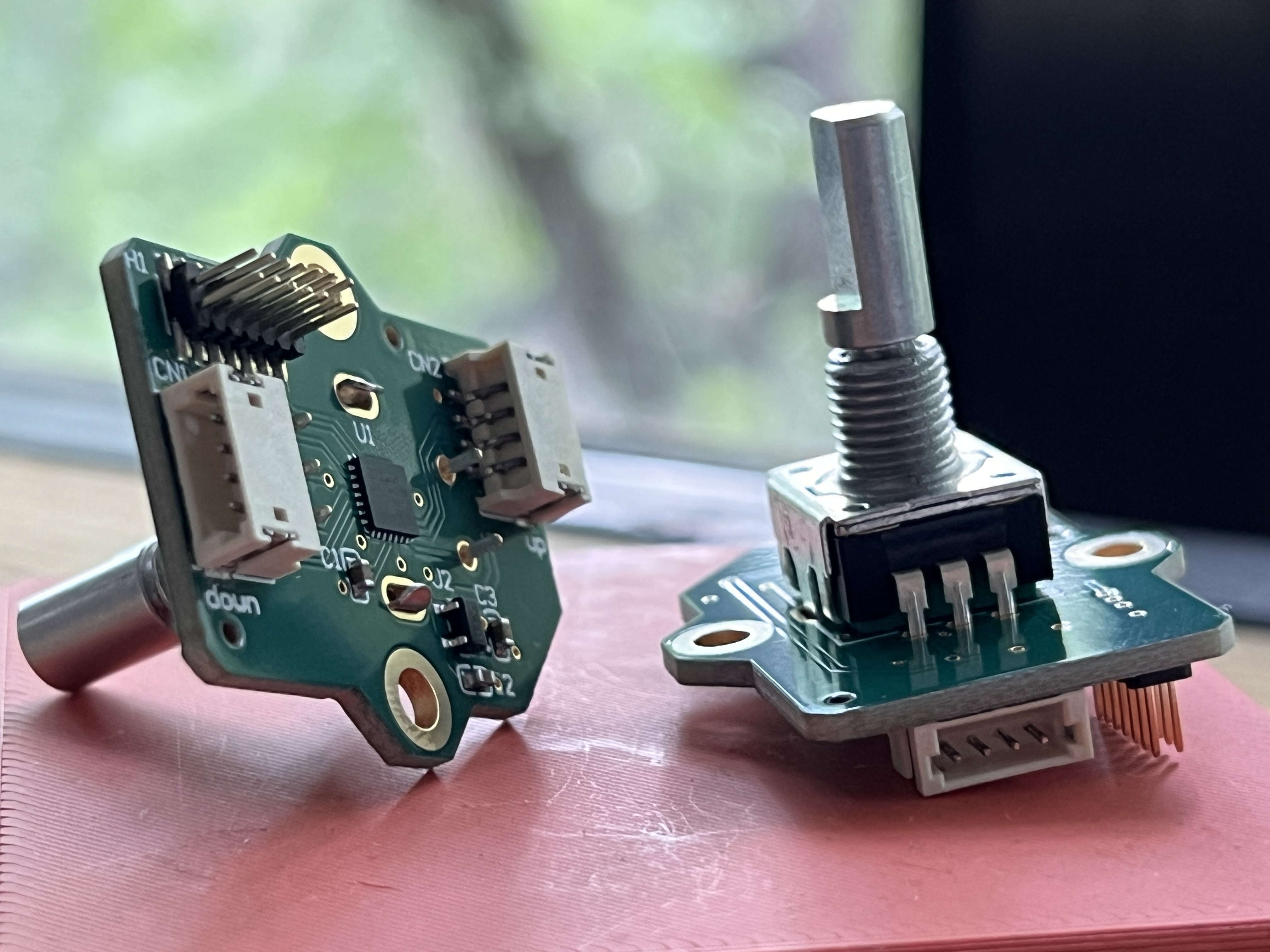
Status: Received and working great. Firmware bring up went smooth, buoys are walkin' and talkin'.
Really stoked on these. They will enable lots of fun things like Lakehouse instruments, large sequencers, interfaces with far apart controls, flywheel encoder stuff, VMK'26 etc. Very excited.
Why?
When the lego blocks are available, we can build with them. Even though H750 Synth Dev Platform was annoying in a few ways, it was extremely valuable and allowed me to come up with and build Pebbles all in a week-ish. I'm also thinking forward to maintainable instruments that are a joy to keep alive and don't force you to trash perfectly good electronics if some piece bites the dust. If you've ever opened a Dave Smith REV2, you know it is just gorgeous in its simplicity. I want my instruments to inspire others the same way the REV2 inspired me.